Build the Prototype That Answers the Right Question.
We design, prototype, iterate, and test to reduce meaningful technical and commercial uncertainty, not to build for its own sake.
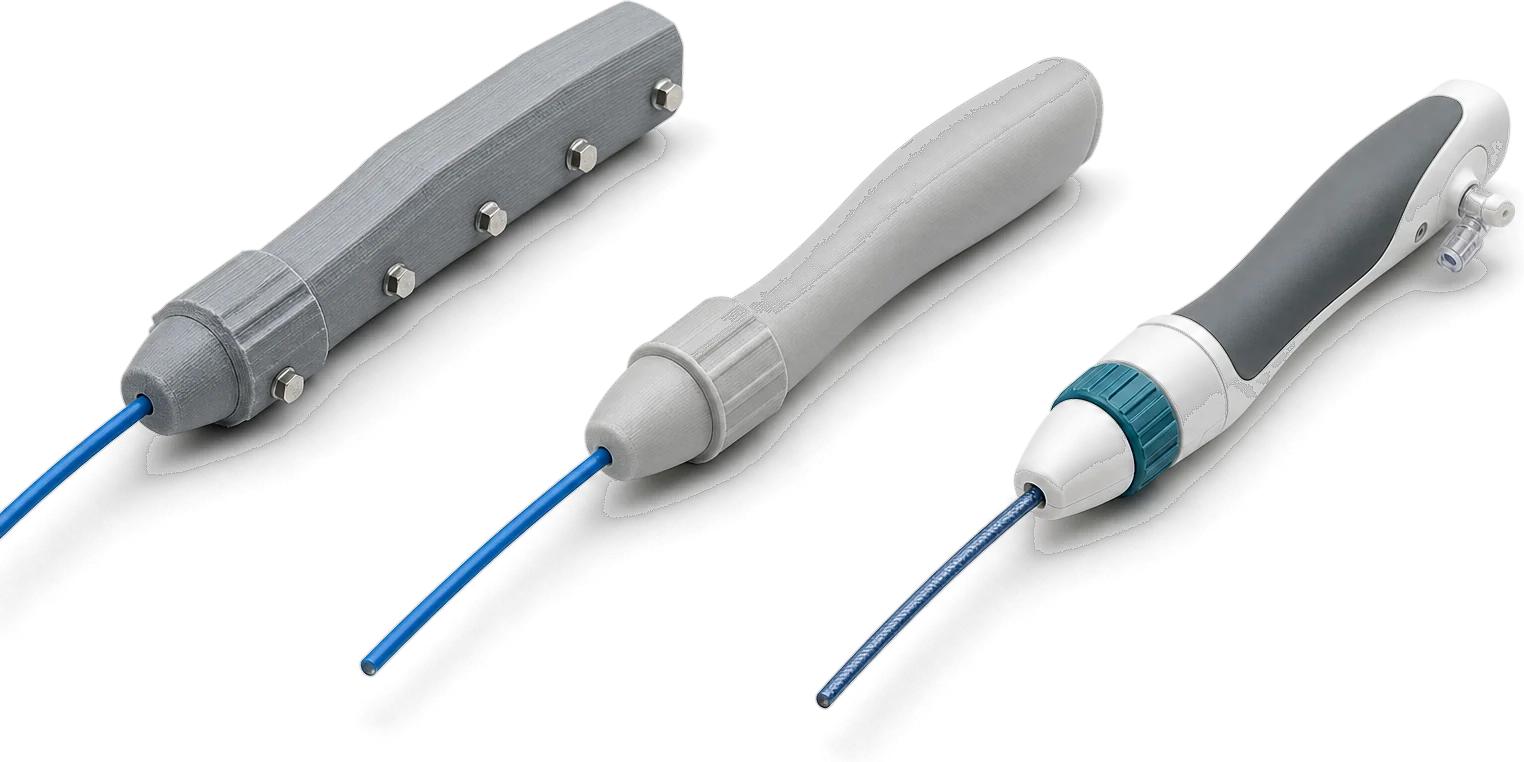
Gen 1 should be the simplest product that delivers meaningful clinical value.
We design and build for learning. We resist complexity that adds cost and failure modes without adding value, and we keep the market in the room while the engineering happens, so the device that works on the bench also works in the business.
Design It So It Can Be Built.
Concept development, CAD and first prototypes, with production in mind from the first model.
Materials, tolerances and assembly steps get chosen with the eventual process in view. That way the prototype that finally works does not have to be redesigned before anyone can make it.
- Concept development and CAD
- Material and process selection
- Tolerance and assembly review
- Target COGS input from the first design review
Build, Test, Learn. On Purpose.
Structured build-test-learn cycles with fixtures, protocols, and data you can put in front of investors and partners.
Each lap retires a specific risk: a mechanism, a material, a use step. The loop stops when the answer is good enough for the next decision, not when the prototype is perfect.
- Functional prototypes
- Test fixtures and protocols
- Bench data packages
- Design iteration between builds
Enter Regulated Development When the Remaining Risks Are Execution Risks.
When invention risks are resolved, we help you enter regulated development with the discipline it requires and none you don't need yet.
Regulated Development: Readiness Checklist
Start with the bench. Regulated discipline applied to a concept still being invented wastes money on both ends.
- Design controls set up for your stage
- Risk management
- Design history documentation
Prove It Does What It Says.
Verification shows the device meets its design inputs. Validation shows it meets the user's needs.
We plan both early, so the test strategy shapes the design instead of arriving after it. A test that fails in planning is free. The same failure in a verification build costs a schedule.
- Verification and validation planning
- Verification testing
- Usability and human factors
- Test documentation to support a submission
“Enter regulated development when the remaining risks are execution risks, not invention risks.”
What Does Your Next Prototype Need to Prove?
Tell us where the device is and what you need to learn next. We'll help you design the build that answers it.